
Bunion Surgery at Norwest Private Hospital Sydney
Bunion Surgery to correct the position of the big toe.
A bunion is a painful or sore bump that occurs on the inside of the big toe. This abnormality of the foot is often called Hallux Valgus meaning big toe turning outwards in Latin and occurs slowly as pressure is placed on the big toe turning it outwards and eventually pressing against or overlapping the second toe.
Due to continual pressing of the big toe outwards, the shape of the bones in the foot changes and the resulting deformities are responsible for the pain experienced while walking or running.
What is bunion surgery?
Bunion surgery is a specialised orthopaedic procedure to surgical correct big toe deformities. It is used for people who are experiencing difficulty walking, continuous pain, or bothersome deformities of their great toe. It is usually undertaken after non-surgical methods have been tried and failed or if the foot deformity has reached a point where it is interfering with daily function.
Although not all bunions need to be operated on, you may choose to undergo the procedure if you experience the following symptoms:
Inflammation of the big toe and swelling of the area that does not improve with rest or medications
Toe deformity especially when the big toe begins to overlap the second or third toe
Failure of non-surgical options to control pain such as anti-inflammatory drugs (ibuprofen), bunion splints, bunion correctors, or changes to footwear
Inability to bend or straighten the big toe
Before undergoing any surgical procedure, it is important to discuss your condition and circumstances with an orthopaedic specialist surgeon.
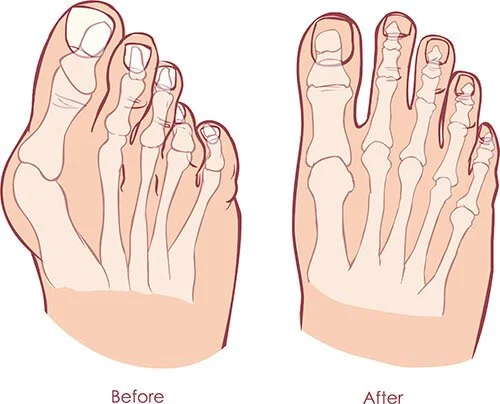
Illustration showing bone deformities in bunions compared to normal feet.
How is bunion surgery performed?
A combination of surgical techniques is used to correct a bunion depending on how much the bones of the big toe are misaligned. The overall goal is to realign the main joint of the big toe (known as the metatarsophalangeal joint or MTP joint), repair the tendons and ligaments of the big toe and foot, and remove any damaged or inflamed tissue.
In most cases, ligaments need to be corrected by tightening or loosening them, so they do not cause the big toe to drift towards the other toes.
The orthopaedic specialist surgeon may also remove some of the bone of the big toe to correct its shape with a procedure called an osteotomy. In most cases, only a small wedge is removed and then the bone is fixed in place with pins, screws, or plates. Osteotomy is done in combination with ligament correction to maintain the big toe shape and alignment.
If there is arthritis of the joint, the orthopaedic specialist surgeon may use a technique called arthrodesis which involves removing arthritic joint surfaces and fusing the bones of the big toe together. However, this procedure is only reserved for those who have severe cases of bunions affected by arthritis or when bunion surgery has previously failed.
The orthopaedic specialist surgeon may directly remove the offending big toe bump with a procedure called an exostectomy. This procedure may relieve symptoms of pain but does not correct the underlying big toe deformity issue. It may be used in conjunction with other surgical techniques to correct a bunion.
Bunion surgery is usually done one foot at a time. This way a patient can retain mobility.
What are some risks and complications of bunion surgery?
Before undergoing any surgery, an orthopaedic specialist surgeon will discuss risks and potential complications with you and answer any questions you might have.
Some risks include:
Wound infection: this occurs in less than 1% of all procedures and can be treated with antibiotics
Nerve damage: there is a small risk to losing sensation of the skin in area surrounding the surgical site, but this is very rare.
Blood clots: with any surgical procedure, there is a small risk of the blood clotting in the vessels causing pain and swelling. If you have known risk factors associated blood clots, the specialist may prescribe you with some blood-thinners during the recovery period. The risks are present but small. If you experience abnormal swelling and pain of the leg, please contact the specialist urgently.
Reappearance of symptoms: Although symptoms rarely reappear after surgery, a small number of people may find that their pain and discomforts return. You may notice a small cosmetic deformity of the foot. If this occurs, please consult with the specialist to discuss further surgical correction.
Over-correction: an imbalance of the ligaments may cause the toe to start drifting towards the other foot. This is very rare though and only occurs in less than 1% of cases.
How much does it cost to have bunion surgery?
The costs to have bunion surgery in Sydney depends on each individual treatment plan. Costs will depend on the treatment outcomes and complexity of the case presented. We provide full costs disclosure before initiating any treatments and therapies.
We accept most major private health insurance funding, and our knowledgeable staff can assist you with the health insurance claims process, but it is always helpful to contact your provider in advance to ensure that your insurance covers the orthopaedic procedure.
In most cases, you may be expected to pay a gap fee, but this is dependent on the cover of your private health insurance.
Associate Professor Roderick Kuo works only in the private health system and unfortunately does not maintain a public system list. However, some conditions may be treated with non-surgical methods such as physiotherapy that can be initiated after a consultation and review of your circumstances.
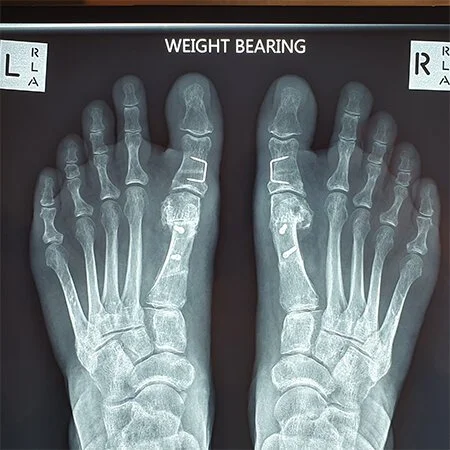
Post-operative X-ray of corrected bunions on both feet
Here’s what to do next…
Research your condition and treatment options
We provide extensive information about Bunions on our conditions page.
Read our FAQ about Bunion Surgery below.
Do further research and contact us with any questions you may have.
Book a consultation with Associate Professor Roderick Kuo
Prior to your appointment, please obtain a referral from your General Practitioner. This will allow you to claim a Medicare rebate on the consultation fees.
Call or email our team at Specialty Orthopaedics to book your consultation.

Frequently Asked Questions about Bunion Surgery
-
Bunion surgery is usually done as an overnight surgery. You will expect to spend at least one night in hospital after the surgery.
-
Prior to surgery, you will be given a local injection around the foot area called ankle block anaesthesia, so you remain pain-free during and after the surgery. Depending on your case, other types of nerve blocking anaesthesia may be used including regional anaesthesia that numb the areas below the knee or spinal anaesthesia that numbs the body below the waist. You may choose to undergo the procedure under general anaesthetic, but your orthopaedic specialist surgeon will discuss these options with you well before the day of surgery.
During the recovery period, you may be prescribed some stronger painkillers to reduce any discomforts. In the recovery and rehabilitation period, you may experience some discomforts, but this can be managed with painkillers.
-
After the procedure is complete, the orthopaedic specialist surgeon will insert metal pins to hold the toes in alignment and bandage your foot to hold the bones in their newly aligned place and protect the surgical wounds while they are healing.
Afterwards you will be sent to the recovery unit and monitored for a period of time to allow the anaesthesia to wear off and your body vitals to normalise. It is important at this time to report any discomfort, pain, or nausea you may have to the doctors as they can assess your need for painkillers or anti-nausea drugs when you are discharged.
You will be referred to a physiotherapist who will start you on a recovery programme. It is recommended that you follow the guidance of the physiotherapy programme as it will speed up your recovery drastically and allow you to get back on your feet sooner.
-
In the first week after the surgery, you should attempt to minimalize moving around unless necessary. This is to ensure the bones are kept in place while healing. You may heel weight-bear on the foot as tolerated but this is not recommended for at least 2 weeks after surgery. You may use assistive devices such as crutches, a knee walker, or a scooter to move around.
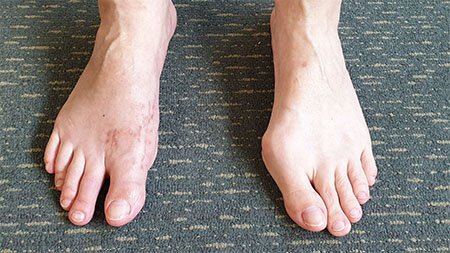
Comparison of bunion surgery to non-corrected foot. The patient presented with severe claw toes in addition bunions. The surgery corrected both conditions by straightened the claw toes with pins.
Comparison of bunion surgery to non-corrected foot. The patient presented with severe claw toes in addition bunions. The surgery corrected both conditions by straightened the claw toes with pins.
Avoid disturbing the bandages and dressings of the foot and follow instructions for the care including keeping them dry during showers.
Attempt to elevate your foot to the level of your heart to reduce swelling and take painkillers whenever you experience pain. This will reduce swelling of the foot, but some swelling may be unavoidable for up to six months.
You may find some blood ooze at the site of the surgery which is normal. However, if you notice bleeding does not stop, please contact the orthopaedic specialist surgeon urgently.
-
For the first 6 weeks, your foot will be bandaged or supported with a special shoe and toe splint. You may heel weight bear as tolerated but do so under advice from your orthopaedic specialist surgeon.
After 6 weeks, you will have an X-ray and if the foot has healed sufficiently, you should be able to fully weight-bear and regain the ability to walk independently without assistive devices. You should consult with the orthopaedic specialist surgeon prior to fully weight-bearing on the foot.
-
Healing and recovery times are different for each individual person. In general, you should be able to return to work in 2-4 weeks if you mostly sit at work. You should allow for up to 12 weeks to recover if your work involves manual labour.
-
The typical follow-up appointments after you have been discharged is as following:
10-14 days after surgery
At the first appointment, the orthopaedic specialist surgeon will remove your bandages and metal pins holding your toes in place. You will be given a toe splint and special supportive shoe.
Six weeks after surgery
At this appointment, the foot will be X-rayed, and the splint and shoe removed. At this time, you should be able to weight-bear on the foot.
Three months after surgery
The orthopaedic specialist surgeon will review your progress at this appointment and if all is well, you will be discharged. It is important to report how if you have any more pain or discomforts in your foot.
Important: Information is provided for guidance only. Individual circumstances may differ and the best way to approach a condition is by individual medical consultation where a specialist can tailor a treatment plan to suit your needs.
Edited by Dr Roderick Kuo
Last updated: 5/5/24